

Service page · Driveways
Block Paving Driveways in Solihull
Block paving driveways in Solihull, Shirley, Knowle and nearby areas. Excavated, restrained, drained and finished with a laying pattern, border and colour choice suited to the property.
Cornerstone
Block paving with structure beneath the finish.
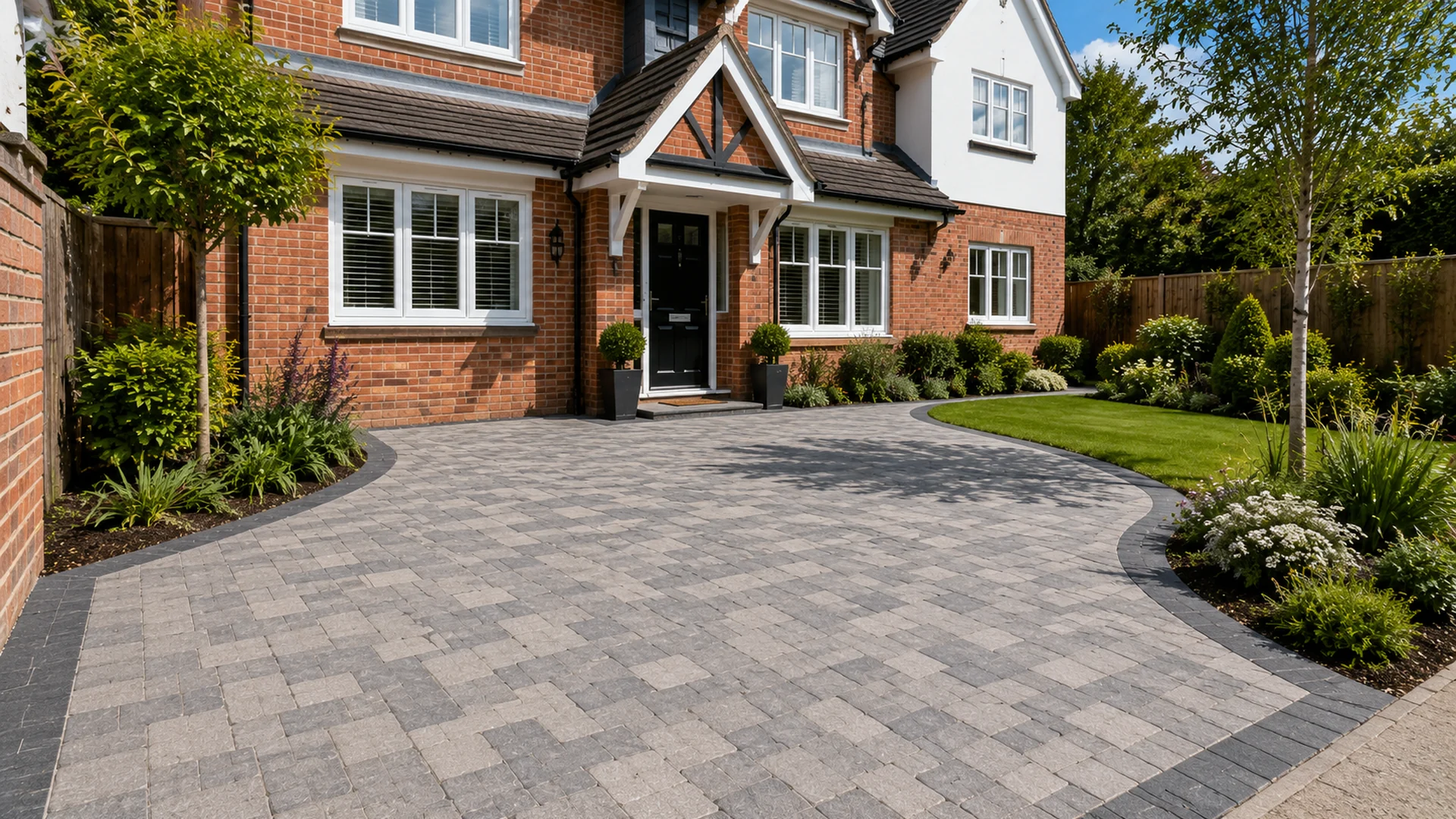
Block paving remains one of the most flexible driveway finishes for Solihull homes. It suits traditional frontages, modern extensions, curved entrances and driveways where a contrasting border or entrance detail will lift the whole property.
The long-term finish depends on the build-up below the blocks. Cornerstone specifies the dig-out, membrane where required, MOT Type 1 sub-base, sharp sand laying course, concrete-bedded restraints, drainage and final compaction before the installation is priced.
Specification
What is included in a block paving driveway.
A block paving installation should be quoted as a groundworks and surfacing package, not just a decorative layer.
- Existing surface stripped out and removed from site
- Excavation to the agreed depth based on use and ground conditions
- Geotextile membrane where separation is required
- MOT Type 1 sub-base installed and compacted in layers
- Concrete-bedded edge restraints, kerbs or border blocks
- Falls set towards the agreed drainage route
- ACO-style channel drainage or soakaway connection where specified
- Sharp sand laying course screeded to level
- Block paving laid to agreed pattern, colour and border detail
- Kiln-dried jointing sand brushed in and surface compacted
Method
Block paving options and laying detail.
Herringbone driveways
A common driveway pattern because it interlocks well under vehicle movement and gives a strong visual rhythm across larger areas.
Borders and kerbs
Charcoal, grey or contrasting borders can define the shape of the drive, frame lawn edges and create a cleaner entrance from the pavement.
Covers and thresholds
Inspection covers, drains, door thresholds and garage entrances are checked so the finished paving sits neatly against the property.
Drainage and levels
Drainage and edge restraint matter.
Loose edges and poor drainage are two of the most common reasons block paving starts to move. Edge restraints hold the paving in place. Falls and drainage control where surface water goes.
For front drives, we check whether the finish can drain to a lawn, border, permeable area, channel drain or soakaway. The drainage route is confirmed before the blocks are laid.
- Concrete-bedded edge restraints or kerb details
- Drainage route agreed before surfacing begins
- Finished levels checked against damp course and air bricks
- Cuts planned around walls, steps, covers and thresholds
- Nearby areas covered: Solihull, Shirley, Knowle, Dorridge, Olton and Balsall Common
Survey notes
Where block paving works well.
These are the details we look for before confirming the written quote, so the scope is based on the site rather than an assumed standard build-up.
- Front driveways needing a smart, structured appearance
- Driveway extensions that need to tie into paths or edging
- Properties where borders or patterns will add definition
- Driveways with inspection chambers that may need future access
- Homes where a repairable surface is preferred over a single continuous finish
Related pages
Useful pages for this project type.
Questions
Common questions.
How long does block paving take to install?
Most domestic block paving driveways take around three to seven working days depending on the area, depth of excavation, access, drainage and weather.
Which block paving pattern is best for driveways?
Herringbone is often chosen for driveways because the interlocking pattern performs well under vehicle movement. Other patterns may suit paths, patios or lighter-use areas.
Does block paving need a border?
A border is not only visual. It helps define the edge of the driveway and works with the concrete-bedded restraint to keep the surface contained.
Can block paving be sealed?
Sealer can be applied where specified, but it should be used at the right time and on a clean, settled surface. It is not always required for every installation.
Ready to discuss your project?
Tell us what you want to achieve and we will arrange a free site visit across Solihull, Birmingham, Warwickshire and surrounding areas.