

Service page · Patios
Porcelain Patios in Solihull
Porcelain patio installation across Solihull and surrounding areas, set out around levels, drainage, paving size, jointing and edge detail.
Cornerstone
Porcelain patios with a clean, consistent finish.
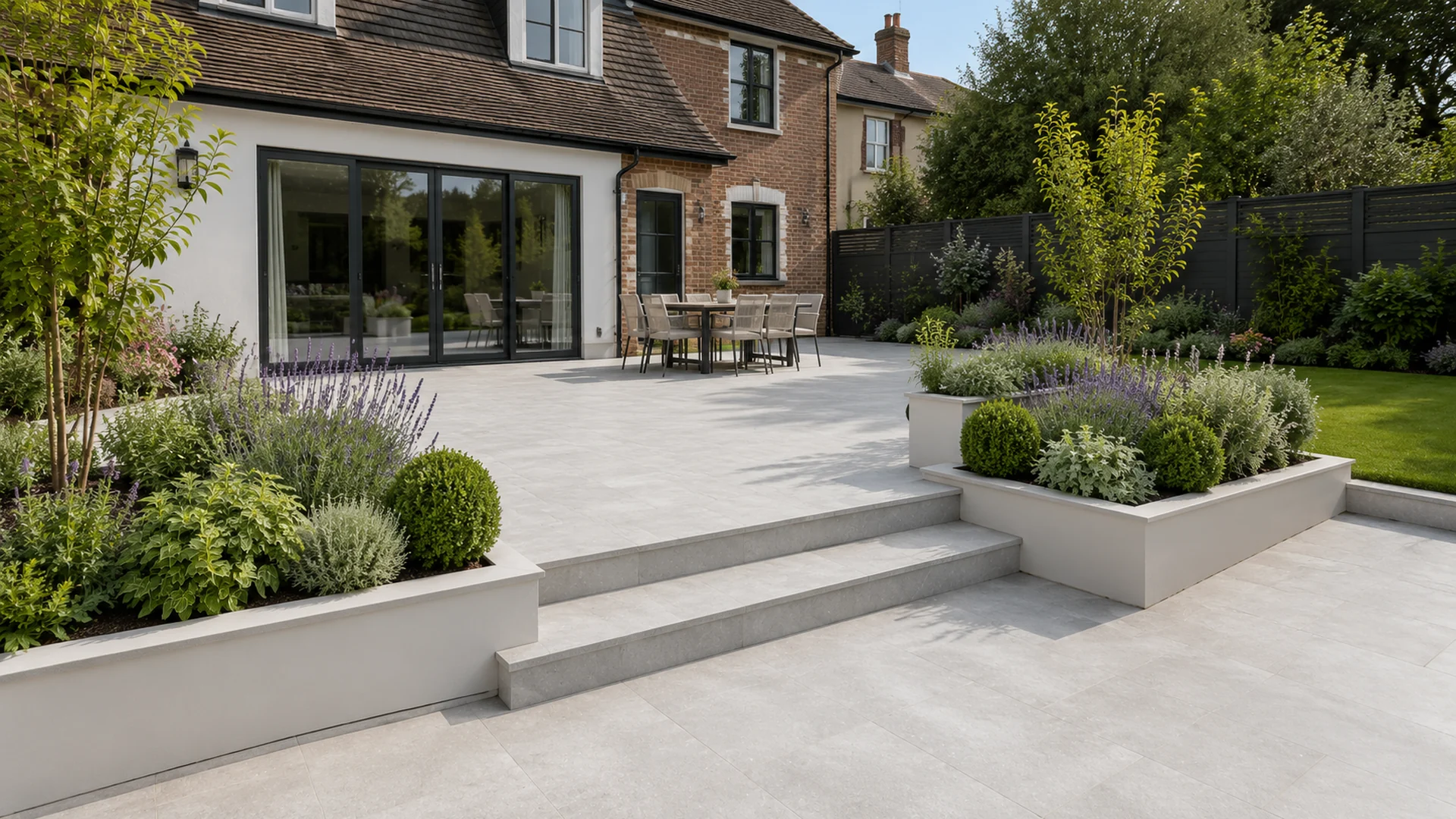
Porcelain is chosen for sharp lines, consistent colour and a modern garden finish. It works well for seating areas, paths, steps and garden layouts where a refined surface is required.
Cornerstone sets out porcelain patios around finished levels, drainage, slab size, cuts, jointing and transitions to lawn, artificial grass or planting. We also install Indian sandstone patios where a more natural variation in tone and texture is preferred.
Specification
What is included in a porcelain patio installation.
Porcelain needs the correct laying method. The preparation, mortar bed, priming slurry, cuts and jointing system all affect the finished result.
- Existing slabs, decking, concrete, lawn or mixed surfaces removed where specified
- Excavation and preparation to the agreed level
- Compacted Type 1 MOT sub-base where required
- Drainage route and falls set before paving starts
- Porcelain paving laid on a suitable full mortar bed
- Priming slurry used to bond the slab to the bed where required
- Clean cuts around walls, steps, drains and thresholds
- Jointing system installed to suit the paving and layout
- Steps, edging and transitions included where specified
- Final clean-down and basic aftercare advice
Method
How porcelain differs from natural stone.
Consistent finish
Porcelain gives a sharper and more uniform surface than sandstone or limestone, with a modern appearance and tight joint lines.
Specified laying method
Porcelain is dense and low-absorption, so the bed, primer and jointing system must be chosen for that material.
Alternative: Indian sandstone
Indian sandstone gives more natural colour variation and texture, suiting gardens where a softer stone finish is preferred.
Drainage and levels
Levels, thresholds and surface water.
A patio close to the house needs finished levels checked against door thresholds, damp course, air bricks and existing gullies.
Falls are set to take water away from the house and towards the agreed drainage point, border, lawn or existing drain where site conditions allow.
- Thresholds and damp course checked before finished level is agreed
- Falls set away from the house where levels allow
- Existing gullies, drains and low points identified
- Step heights and transitions planned before paving begins
- Nearby areas covered: Solihull, Shirley, Knowle, Dorridge, Hampton-in-Arden and Balsall Common
Survey notes
Common porcelain patio issues we design around.
Porcelain looks sharp when the layout is planned before cutting starts. The survey confirms levels, access and drainage so the finished patio feels part of the garden.
- Paving laid too high against the house
- Awkward cuts around drains, walls and steps
- Poor falls causing standing water
- Unsuitable bedding or missing primer
- Jointing colour that clashes with the paving
- A hard edge between patio, lawn and planting areas
Related pages
Useful pages for this project type.
Questions
Common questions.
Is porcelain better than Indian sandstone?
Neither is automatically better. Porcelain gives a cleaner and more consistent finish. Indian sandstone gives more natural variation and texture.
Does porcelain need sealing?
Many porcelain products do not need sealing in the same way as natural stone, but cleaning and aftercare advice depends on the product chosen.
Can porcelain be used for steps?
Yes. Steps can be included when the heights, edges and nosing details are specified before work begins.
Do you also install Indian sandstone?
Yes. Indian sandstone patios and paths can be quoted as a separate finish or as part of a wider garden project.
Ready to discuss your project?
Tell us what you want to achieve and we will arrange a free site visit across Solihull, Birmingham, Warwickshire and surrounding areas.